How to Choose Furniture for an Open-Plan Room
Open-plan rooms reward one decision above all others: define your zones before you choose a single piece. Without walls to separate spaces, furniture does the structural work. Sutter & Vale carries Caracole's living collection specifically because its pieces are designed to coordinate across categories, making that structural work easier to get right.
What Makes Open-Plan Rooms So Hard to Furnish?
Scale and cohesion are the two problems that trip most buyers. Furniture that reads correctly in a standard room can disappear in an open plan, and pieces chosen independently can make a large floor feel like a collection of unrelated decisions. Solve scale first, then cohesion follows.
How Do You Define Zones Without Walls?
Anchor each zone with one large, grounded piece, then build outward from it.
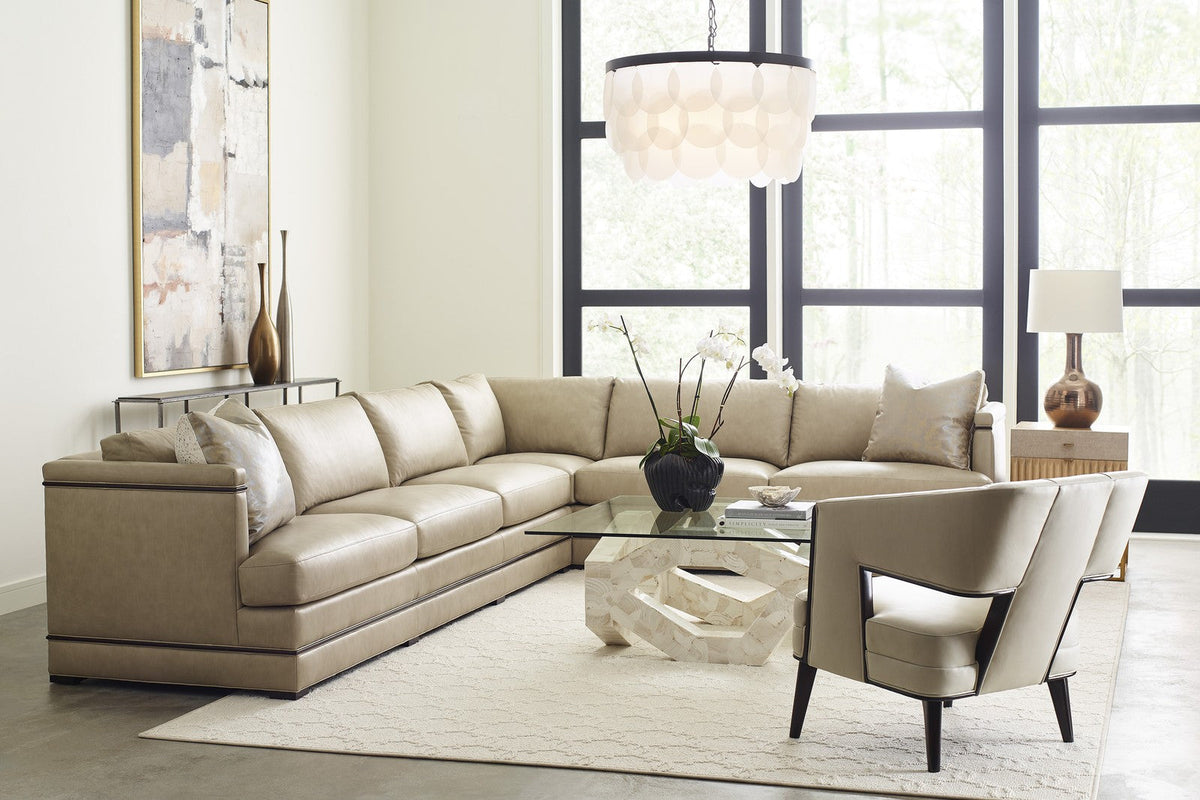
A sectional is the most reliable anchor for a seating zone. Its footprint is generous enough to hold a conversation area even when the room opens in every direction. The Sasso RAF Armless Loveseat in Saffron, at 90.16 inches wide, carries enough visual weight to hold a zone on its own, and its modular format lets you extend or reduce the configuration as the room demands.
What Size Rules Apply to Open-Plan Layouts?
Scale up more than instinct suggests, and use these general benchmarks:
- Leave at least 30 to 36 inches of circulation path around any major seating group
- A coffee table should sit 14 to 18 inches from the front of your sofa
- Rugs anchor zones most effectively when all front legs of the seating sit on them
- Deeper seats, 52 inches or more, read as substantial rather than token in a large room
How Do You Keep an Open Plan Feeling Cohesive?
Repeat materials and tones across the room, not shapes.
Caracole builds collections designed to work across upholstery, casegoods, lighting, and accents. A fabric or finish introduced on one piece can carry through to surrounding pieces without the room looking matched. The Sasso RAF Curved Armless Loveseat in Oatmeal, at 87.6 inches wide, holds its own in an open plan while its neutral tone keeps the broader palette open for layering. Where you want a focal point, one sculptural silhouette held in a consistent fabric family with surrounding pieces gives the room a center of gravity.
Does Modular Furniture Work Better Than Fixed Sofas Here?
For most open plans, modular components offer more control.
They let you reconfigure as the room's use changes and test a layout before committing. Key considerations when choosing modular:
| Factor | What to Look For |
|---|---|
| Connector system | Pieces that link or separate cleanly |
| Fabric consistency | All components available in the same cloth |
| Seat depth | 52 inches or more reads as substantial |
| Arm options | Armless units increase flexibility at corners and ends |
Frequently Asked Questions
Can one sectional do the work of a whole seating zone in an open plan?
A well-scaled sectional is usually sufficient to define a seating zone on its own. Pair it with a rug and a low table to close the group visually without adding more seating than the space needs.
How do I stop an open-plan room from feeling like a furniture showroom?
Limit the number of distinct furniture families in the room to two or three. Caracole collections are built to coordinate across categories, which makes that restraint easier to maintain.
Should all zones in an open plan use the same style of furniture?
Not necessarily. A consistent material palette and shared tonal range will unify zones even when the forms differ. A dining chair with a different profile than your sofa reads as intentional when the finishes echo each other.
The Sutter & Vale Team