Baker Dining Chairs and Tables: The Grand American Dining Room
Baker Furniture has shaped the American dining room since 1890, and the range available through Sutter & Vale covers every seat at the table. The Baker collection moves from compact armless side chairs to cast-bronze statement tables, all built on hand-applied finishes, solid hardwood joinery, and an upholstery program the house compares to couture fashion.
What Is Baker's History in the American Dining Room?
Baker has been building dining rooms for well over a century. Founded in 1890 by Siebe Baker in Allegan, Michigan, the house introduced its Manor House collection in 1932, described as the first great furniture reproduction program in America. In 1951, Baker partnered with Finn Juhl to bring Danish Modern to the American market. That fact alone reframes the house: an aesthetic now considered mainstream entered American homes through Baker.
The current Susan Ferrier Collection extends that record. It draws on tectonic shifts, flowing magma, and volcanic eruptions, incorporating cast bronze, oak, leathered stone, polished marble, shagreen, and onyx. It gives a dining room a focal point built from material, not decoration.
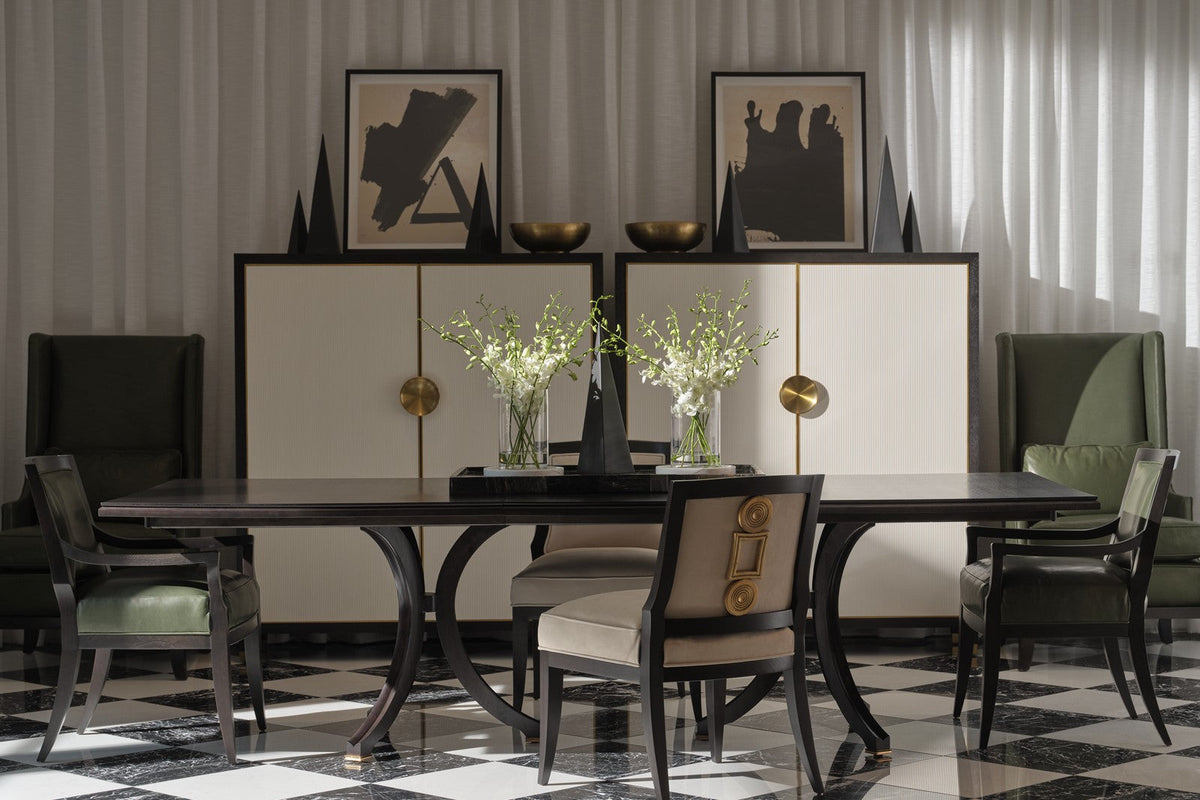
Which Baker Dining Chairs Suit a Formal Dining Room?
The right chair depends on table scale, upholstery program, and how much visual weight the frame should carry.
| Chair | Character | Best pairing |
|---|---|---|
| Bercut Dining Side Chair | Architectural, armless, proportioned frame | Long rectangular tables, six to ten seats |
| Hayes Dining Side Chair | Clean hardwood frame, hand-applied finish | Transitional rooms, round or oval tables |
| Ezra Side Chair | Solid hardwood joinery, COM-ready | Designer-specified rooms with custom fabric |
| Zara Side Chair | Substantial frame, flexible upholstery | Larger rooms needing visual weight |
| Alameda Dining Side Chair | Compact silhouette | Smaller dining rooms, breakfast rooms |
The Swivel Dining Chair adds rotational flexibility without losing the tailored silhouette Baker's upholstery construction demands, making it a useful choice where a dining chair also needs to serve a side table or reading corner in the same room.
How Does Baker's Upholstery Process Affect a Dining Chair?
Baker describes its upholstery as the couture fashion of furniture. Fabric is hand-cut, premium, and basted and re-basted to match the flow of each silhouette. At a dining chair, that process matters most: the seat and back take daily contact, and the cover must hold its shape at every seam.
Several chairs accept customer's own material (COM). The Ezra Side Chair is built on solid hardwood joinery and specified in fabric or COM, making it the right frame when a designer has a particular textile in mind. The Carson Side Chair takes a different approach: the refined wooden frame carries most of the visual work, keeping upholstery secondary to structure.
Construction terms worth knowing when reading Baker specification sheets:
- Baker Comfort Cushion: the standard seat system across the range
- Tight seat / tight back: upholstery pulled directly over the frame, no separate cushion
- Loose reversible seat: a cushion that flips and wears evenly over time
- Double stitch / modern stitch: seam finishing visible at the seat edge
How Do You Size a Baker Dining Table and Chairs?
Standard sizing rules apply, and Baker's proportions are built to them.
- Allow 24 inches of table width per seated diner as a minimum; 30 inches gives more comfort.
- Chair seat height typically runs 18 inches. Confirm at least 12 inches of apron clearance above the seat.
- A table seating eight needs 84 to 96 inches in length. Ten seats call for 108 to 120 inches.
- Leave 36 inches between the chair back and any wall or buffet when the chair is pulled out; 48 inches suits a formal room.
Baker's case goods and upholstery are produced at the house's Hildebran, North Carolina facilities, with additional international production. Confirm all dimensions against your floor plan before specifying.
Frequently Asked Questions
Can Baker dining chairs be specified in my own fabric?
Yes. Several chairs in the Baker range are offered with COM, meaning you supply the fabric and Baker's workroom applies it using the same hand-cut, basted construction used for the house's own textiles. Confirm COM availability on the specific chair's product page and check yardage requirements before ordering.
Are Baker dining chairs built for everyday use or only formal occasions?
Baker builds for durability. Solid hardwood joinery, hand-applied finishes, and tight upholstery construction are specified to hold up under regular use, not only occasional entertaining. The finish and fabric you choose will affect long-term maintenance more than the underlying structure.
How do Baker's standard finish names help when coordinating a dining room?
Baker's standard finishes draw from a fire and geology register: Hraun, Magma, Smolder, Scorch, Anneal, Temper. These names appear consistently across case goods and chair frames, which makes it straightforward to match a dining table finish to a side chair finish within the Baker line. Confirm that both pieces share the same finish option before placing the order.
The Sutter & Vale Team