Round, Oval or Rectangular: Choosing a Dining Table Shape
Round, oval or rectangular: the shape of your dining table determines how a room feels, how many guests you seat, and how easily people move through the space. Theodore Alexander's dining tables at Sutter & Vale span all three forms, making the comparison concrete and specific.
Which table shape works best for a square dining room?
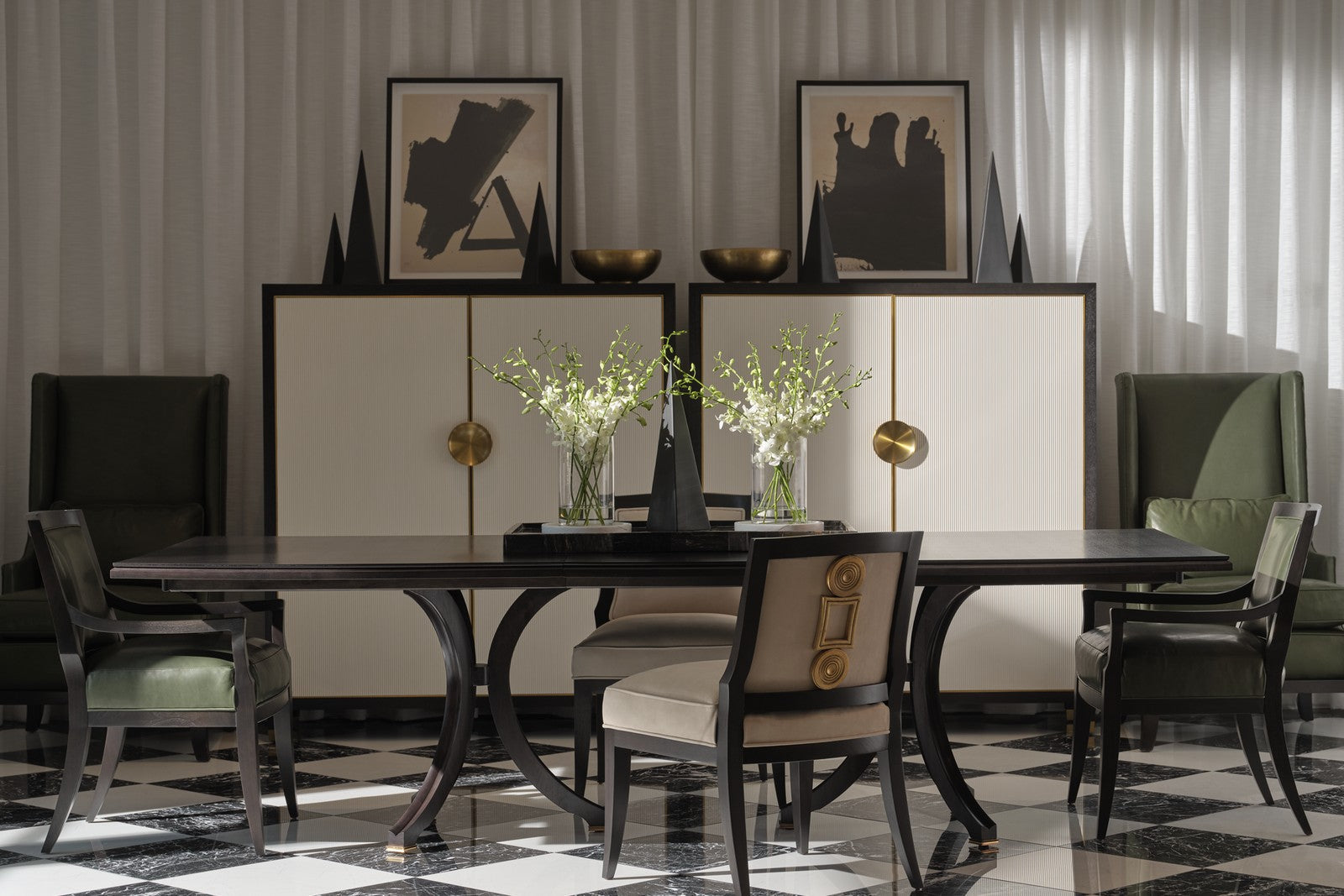
A round table is almost always the right answer in a square room. It echoes the room's equal proportions, leaves comparable clearance on all sides, and keeps every seat equidistant from the center. The Surrey Jupe Dining Table, at 78 inches in diameter, shows how a generous round form can anchor a square space without crowding the walls, provided you allow at least 42 inches of clearance on every side for chairs and passage.
How many people does each shape seat at a standard size?
Seating capacity depends on diameter or length, not shape alone. A useful rule: allow 24 inches of table edge per person.
| Shape | Typical size | Seats |
|---|---|---|
| Round | 60 inches diameter | 6 |
| Round | 68 inches diameter | 6 to 8 |
| Round | 78 inches diameter | 8 |
| Rectangular | 84 to 96 inches | 6 to 8 |
| Rectangular | 132 inches | 10 to 12 |
The Spencer London Round Dining Table, at 68 inches in diameter, seats six comfortably and eight for a dinner party. The Spencer St. James Rectangular Dining Table, at 132 inches, handles ten to twelve.
When does a rectangular table make more sense than a round one?
A rectangular table suits a long, narrow room. It runs parallel to the room's axis, preserves clearance on the long sides, and makes it easy to add leaves or seat more guests end to end. It also anchors a formal dining room with a clear head-of-table arrangement, which suits some households and entertaining styles better than the democratic equality of a round.
What is an oval table good for, and when should you choose one?
An oval table gives you the soft geometry of a round with the seating capacity of a rectangle. It reads as approachable rather than formal, and its lack of sharp corners reduces the sense of crowding in a tighter room. It works especially well in rooms that are slightly longer than they are wide, where a true rectangle can feel too assertive and a round too small.
Does table shape affect conversation at dinner?
It does, in a practical way. At a round table, every person can see and speak to every other person without raising their voice across a long surface. That changes at diameters above 72 inches, where across-table conversation becomes harder. Rectangular tables focus conversation in clusters along each side. Oval tables sit between the two: better sight lines than a long rectangle, slightly harder than a round once the length exceeds about 84 inches.
Frequently Asked Questions
How much clearance should I leave around a dining table?
Plan for at least 36 inches between the table edge and the nearest wall or piece of furniture. Forty-two inches is more comfortable, and 48 inches allows two people to pass each other behind a pulled-out chair without difficulty.
Can a round table work in a large rectangular room?
Yes, but it needs a strong visual anchor, such as a substantial rug, to keep it from floating. A round table placed correctly within a rectangular room can create an intimate dining zone within a larger open-plan space, as long as the diameter is proportional to the rug and the room.
What is a Jupe table, and why does it matter for seating flexibility?
A Jupe table is a round table that expands by rotating its top sections outward and inserting leaves in the gaps, a mechanism developed in the early nineteenth century. It gives you the social geometry of a round table for everyday use and the capacity of a much larger table when you need it.
The Sutter & Vale Team